planners & guides
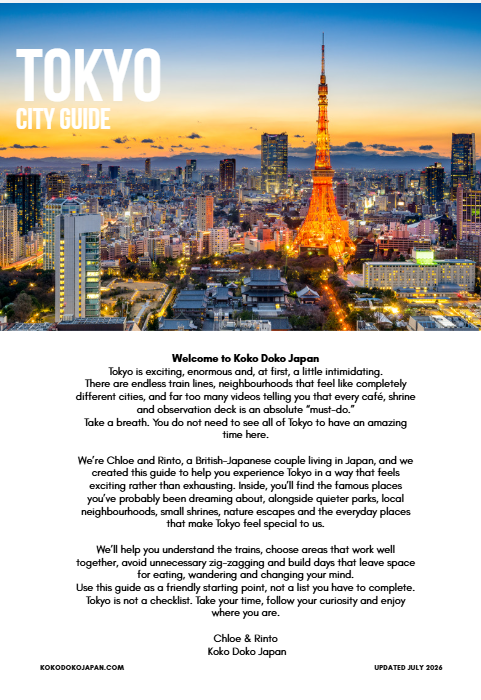
Tokyo is exciting right up until you realise it's not one city — it's about fifteen, all stacked on top of each other, all screaming for your attention at once.
This guide is our answer to that. It's a friendly, realistic Tokyo travel guide built for first-time visitors who want a trip that feels exciting, not exhausting — no 6am starts, no trying to "do" all of Tokyo in three days, no itinerary that looks great on paper and wrecks you by 2pm.
Instead of a giant list of attractions, we group Tokyo the way it actually works: by neighbourhood, by flow, and by how tired your feet will be afterwards.
What's inside:
A simple way to understand Tokyo's layout before you start planning
Airport transfers and your first hour in the city, explained without the jargon
Tokyo trains and IC cards, made genuinely simple
Ready-made day blocks (Shibuya + Harajuku + Omotesando, Asakusa + Ueno + Akihabara, and more) that flow properly instead of zig-zagging across the city
Where to stay, area by area, with the trade-offs actually spelled out
Food chains worth knowing, quiet Tokyo neighbourhoods, parks, shopping, anime and gaming spots
Money, connectivity and emergency basics for peace of mind
Common Tokyo mistakes, sample 3-day and 5-day itineraries, and answers to the questions first-timers always ask
Written by Chloe and Rinto, a British/Japanese couple based in Japan. This isn't generic internet advice. It's what we'd actually tell a friend before their first trip.
Plan well. Leave room to wander.
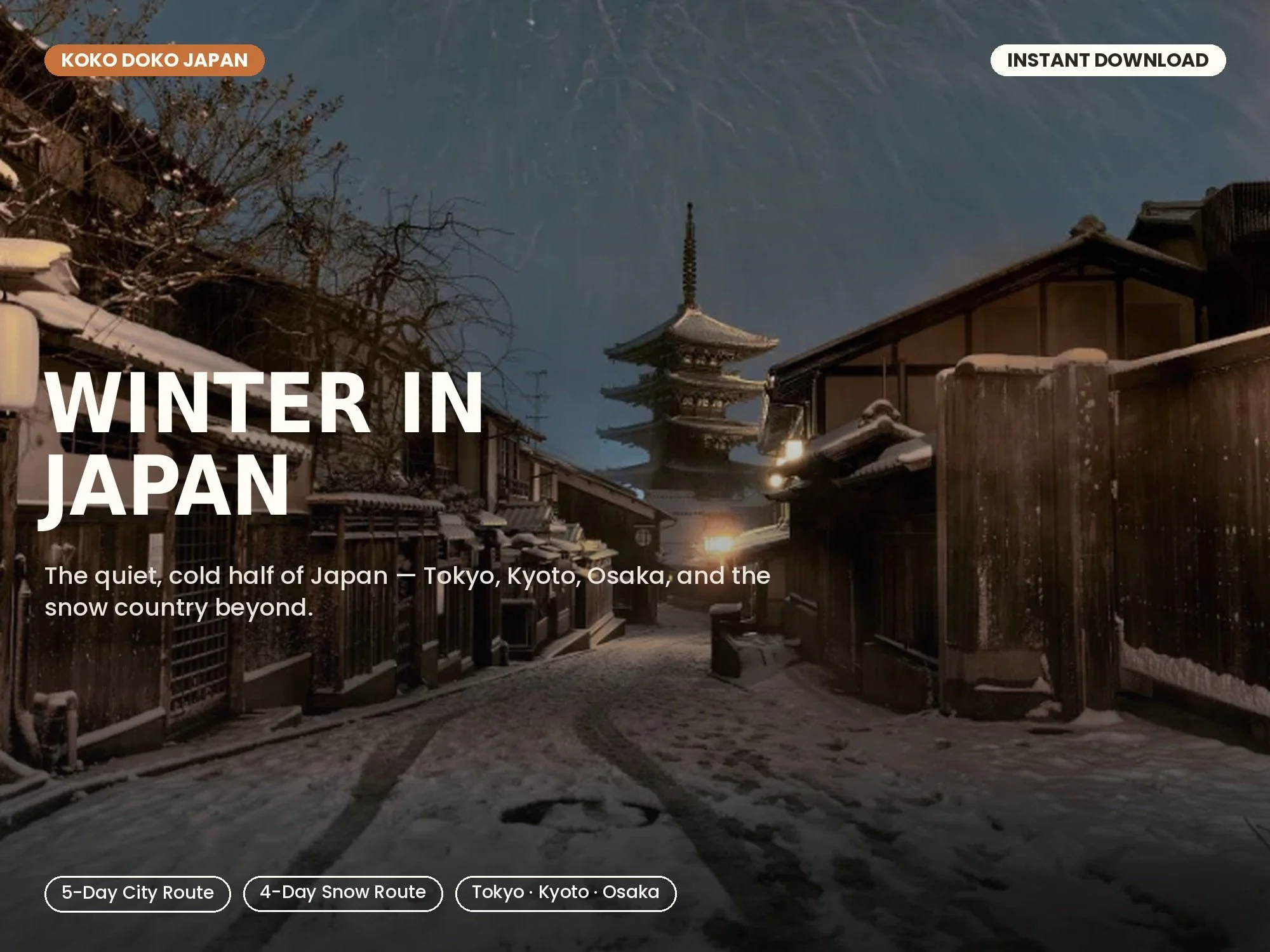
Winter is the quiet half of Japan, shorter queues, glass-clear cold air, and an excuse to spend most of the day warming back up over good food.
This 10-page guide covers Tokyo, Kyoto, and Osaka in the cold months, plus a snow-country detour to Nozawa Onsen and Hakuba if you want to add skiing to the trip. Two ready-made routes are included, a 5-day city route and a 4-day snow route, along with the specific spots we'd actually go back to, how the onsen bath works (including options if you have tattoos), what winter in Japan actually tastes like, and a full packing list so you're not guessing what to bring.
Instant digital download. Read it on your phone, tablet, or print it out before you go.
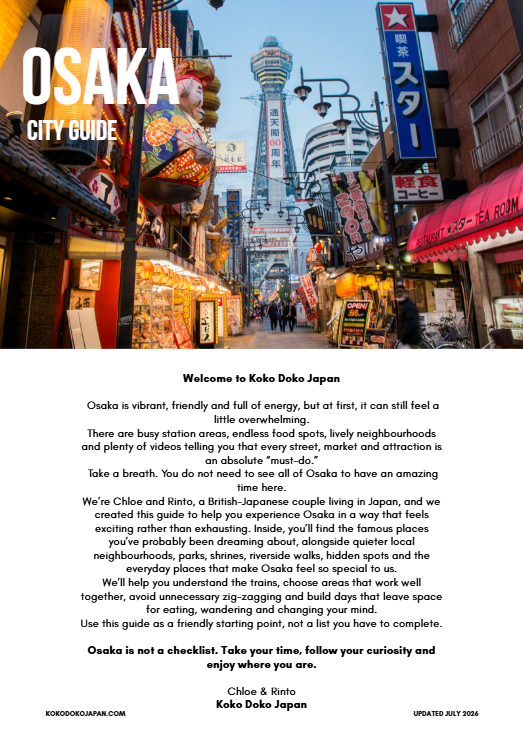
Osaka doesn't ask you to be precious about it. It's loud, it's food-obsessed, and it's usually the city people fall for hardest once they stop treating it like a Kyoto detour.
This guide is our love letter to Japan's kitchen — built for first-time visitors who want to eat properly, wander without a rigid schedule, and actually understand how the city fits together before they land. No pretending you need five days of temples here. Osaka rewards a looser plan.
Instead of a flat list of sights, we group the city the way it actually works: by area, by energy level, and by how hungry you're likely to be.
What's inside:
A simple way to understand Osaka's shape — Kita/Umeda vs. Minami/Namba, and where Tennoji and the Bay Area fit in
Airports, trains, the "train code" (local, rapid, express, limited express) and rush-hour survival, explained without jargon
Five ready-made area blocks — Namba & Dotonbori, Umeda & Kita, Shinsekai & Tennoji, Osaka Castle & Riverside, Bay Area & USJ — each with a simple day shape
Where to stay, area by area, with the trade-offs actually spelled out
What to eat, from takoyaki and okonomiyaki to kushikatsu — plus a real cheat-sheet of everyday chains worth recognising on the street (Ichiran, Sukiya, CoCo Ichibanya and more)
Local neighbourhoods, parks, shrines and shopping beyond Dotonbori
Nightlife areas, from Ura-Namba's standing bars to Kitashinchi's more polished side
Easy day trips (Kyoto, Nara, Kobe, Himeji, Koyasan) — and a warning against turning your whole Osaka trip into someone else's itinerary
Sample 2-day and 3-day plans, common mistakes, and answers to the questions first-timers always ask
Written by Chloe and Rinto. This isn't generic internet advice. It's what we'd actually tell a friend before their first trip.
Busy is fine. Random is not.
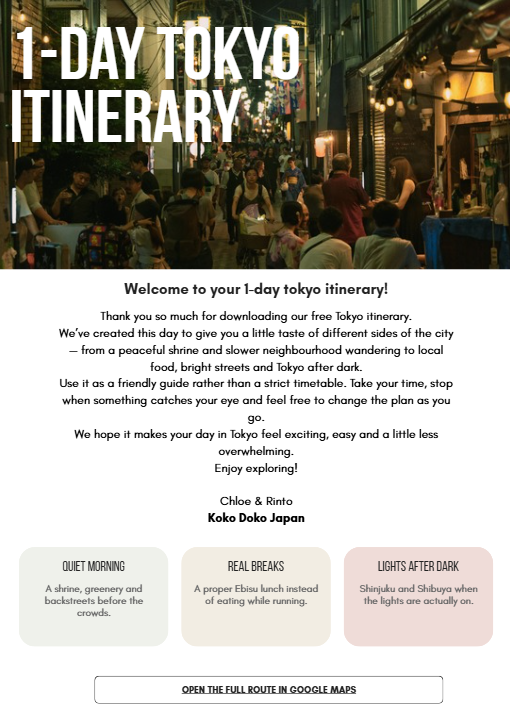
Not sure where to begin with Tokyo? We’ve planned a realistic one-day route that lets you experience both the peaceful and energetic sides of the city—without spending the whole day rushing between distant attractions.
Start with a quiet morning at Nezu Shrine, enjoy a slower wander through Ebisu, then finish the day surrounded by the bright lights and evening atmosphere of Shinjuku and Shibuya.
Created by Chloe and Rinto, a British-Japanese couple living in Japan, this itinerary combines a traveller’s perspective with local knowledge to help your day feel exciting, manageable and genuinely enjoyable.
Inside, you’ll find:
A simple morning-to-evening route
Suggested timings and transport guidance
Practical Koko Doko travel tips
Clickable Google Maps links
Flexible alternatives if you want to slow down or change the plan
Links to our Japan planners, city guides and personalised services
This itinerary is designed as a friendly starting point, not a strict schedule. Stop for food, follow interesting streets and leave space for the small discoveries that make Tokyo memorable.
Format: Three-page digital PDF available for instant download. No physical item will be posted.
Q. What are Koko Doko digital guides?
A.Our digital guides are downloadable Japan planning resources made for first-time travellers who want to plan their own trip, but don’t want to feel completely overwhelmed.
They’re designed to help you understand the Golden Route, organise your ideas, avoid common planning mistakes and feel more confident before you go.
Q. Who are the digital guides for?
A. Our guides are best for people planning their first Japan trip, especially if you’re visiting Tokyo, Kyoto and Osaka and want a clear place to start.
They’re ideal if you enjoy planning your own trip, but still want friendly guidance, useful tips, checklists and structure.
Q. Are the guides personalised to my trip?
A. No. Our digital guides are self-guided resources, so they are not personalised to your exact dates, budget, interests or travel style.
If you’d like personalised feedback on your actual itinerary, our itinerary check and planning services will be available separately.
Q. What’s included in the guide?
A. This depends on the guide you buy, but our planning guides may include things like:
Golden Route planning advice
Tokyo, Kyoto and Osaka tips
suggested 7, 10 and 14-day route ideas
city split guidance
area grouping advice
booking reminders
transport and luggage notes
common first-timer mistakes
checklists and planning pages
Google Sheets planner access, where included
Each product page will clearly explain exactly what’s included before you buy.
Q. What is the Google Sheets planner?
A. The Google Sheets planner is a simple digital spreadsheet to help you organise your own Japan trip.
You can use it to plan your route, daily itinerary, hotels, bookings, transport, budget, links, notes and checklists all in one place.
It is designed to work alongside the guide, so you can use our advice while building your own trip.
Do I need Google Sheets to use it?
Yes, if your guide includes a Google Sheets planner, you’ll need a free Google account to make your own copy and edit it.
We’ll include simple instructions so you know how to save and use your own version.
Q. Can I print the guide?
A. Yes. Our PDF guides can be downloaded and printed if you prefer planning on paper.
Just keep in mind that colours and layout may look slightly different depending on your printer and settings.
Q. Can I use the guide on my iPad or tablet?
A. Yes. You can open the PDF on your tablet and use apps like GoodNotes, Notability or similar PDF annotation apps if you like planning digitally.
The Google Sheets planner can also be used on a laptop, tablet or phone, although it’s usually easiest to edit on a laptop.
Q. Is this the same as a personalised itinerary?
A. No. The digital guide helps you plan your own trip using our advice, but it does not include personalised itinerary feedback, custom day-by-day planning, booking support or messaging support.
It’s a great starting point if you want to organise your own trip, but it is not the same as booking a Koko Doko planning service.
Q. Will you book hotels, trains, restaurants or activities for me?
A. No. Our digital guides are for planning support only.
We do not book flights, hotels, trains, restaurants, activities, tickets or tours on your behalf.
Q. Can I ask questions after buying?
A. The digital guides do not include one-to-one planning support.
If you have an issue accessing your download, please contact us and we’ll help. But personalised trip questions, itinerary reviews and travel advice are not included with the digital guide purchase.
Q. Can I share the guide with someone else?
A. Your purchase is for personal use only.
You’re welcome to use it for your own trip or with the people travelling with you, but please don’t share, resell, copy or upload the guide or planner anywhere else.
Q. Will the guides be updated?
A. We’ll do our best to keep our guides useful and up to date, especially where travel basics, booking advice or common planning tips change.
However, Japan travel information can change, so we always recommend double-checking opening hours, ticket rules, train times and booking requirements directly before you go.
Q. Are the guides suitable for families, couples or solo travellers?
A. Yes. The guides are designed to be useful for different types of first-time travellers.
That said, they are general planning resources, so if you have very specific needs, mobility concerns, dietary requirements or a complex route, you may prefer a personalised planning service.
Q. Are refunds available?
A. Because our digital guides are instant-download products, we usually cannot offer refunds once the file or planner link has been accessed.
If something goes wrong with your download or access, please contact us and we’ll do our best to fix it.
Q. Which guide should I start with?
A. If you’re planning your first Japan trip and don’t know where to start, we recommend starting with:
Our guide to the Golden Route
Our simple Golden Route guide and Google Sheets planner for Tokyo, Kyoto and Osaka.
It’s designed to help you understand the route, organise your ideas and start building a trip that actually makes sense.
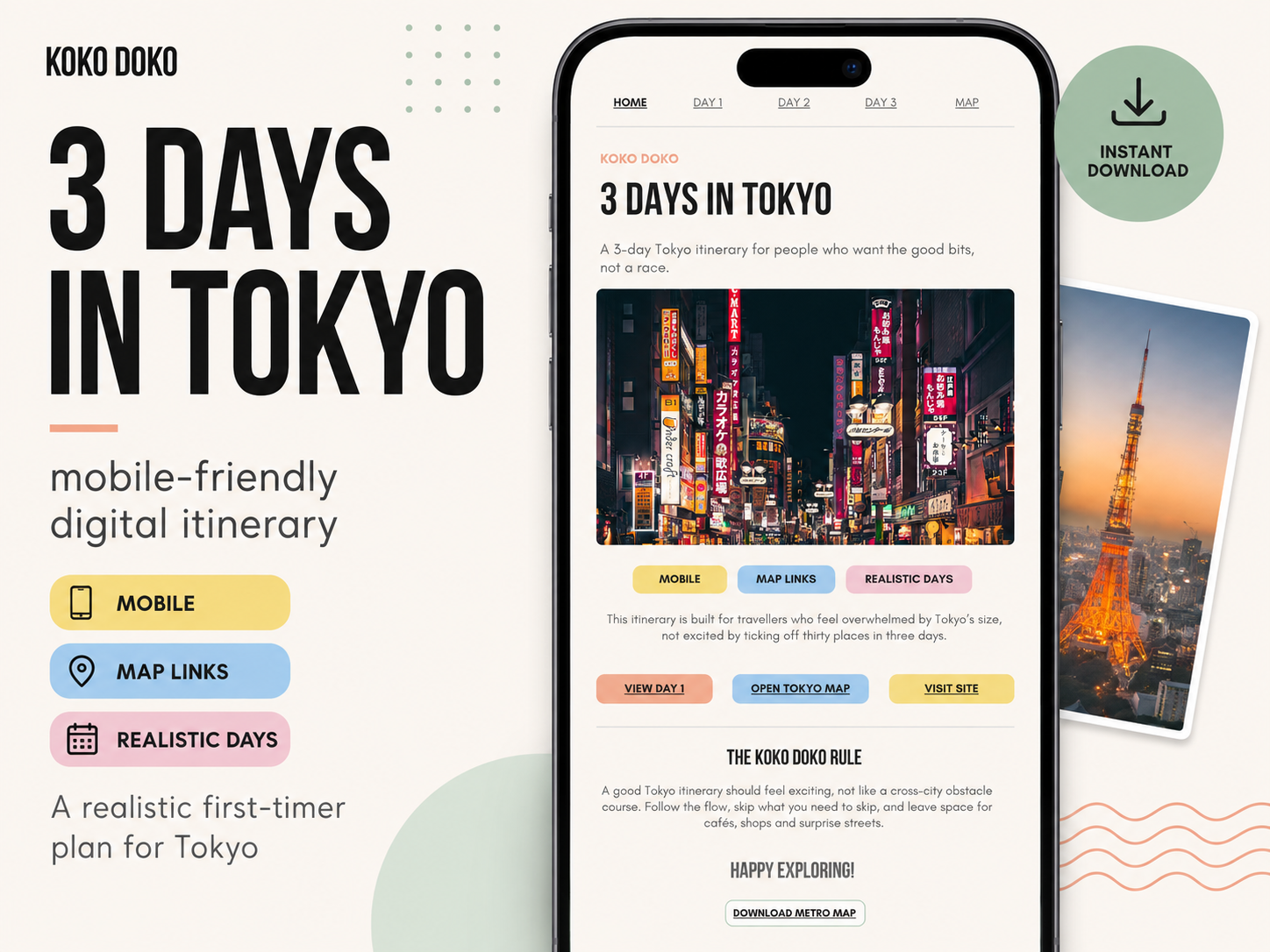
Tokyo is huge. Your itinerary doesn’t need to be.
Our 3-Day Tokyo Itinerary is made for first-time visitors who want to see the city properly without spending three days racing between attractions.
Instead of cramming in as much as possible, we’ve grouped each day by area so your route actually makes sense. You’ll spend less time zig-zagging across Tokyo and more time exploring, eating, shopping and enjoying where you are.
What’s included
3 realistic morning-to-evening Tokyo routes
Neighbourhoods grouped together for easier travel
Suggested timings for each part of the day
Helpful train and transport tips
Easy swaps if a stop isn’t your thing
Clickable map and travel links
Practical advice for first-time visitors
Traveller perspective + local Japan knowledge
Designed for your phone
This is a mobile-first digital PDF, made to be opened while you’re actually travelling.
Check your next stop, tap through to maps and useful links, then carry on with your day — no giant travel guide or complicated spreadsheet required.
Who is it for?
Perfect if you’re:
visiting Tokyo for the first time
overwhelmed by how much there is to see
worried about planning unrealistic days
looking for a simple ready-made Tokyo itinerary
someone who prefers a relaxed trip over a packed checklist
The Koko Doko approach
A good Tokyo itinerary should feel exciting, not exhausting.
Use the plan as your starting point, skip what you need to skip, stop somewhere unexpected and leave room to wander.
Digital PDF • Mobile-friendly • Instant access
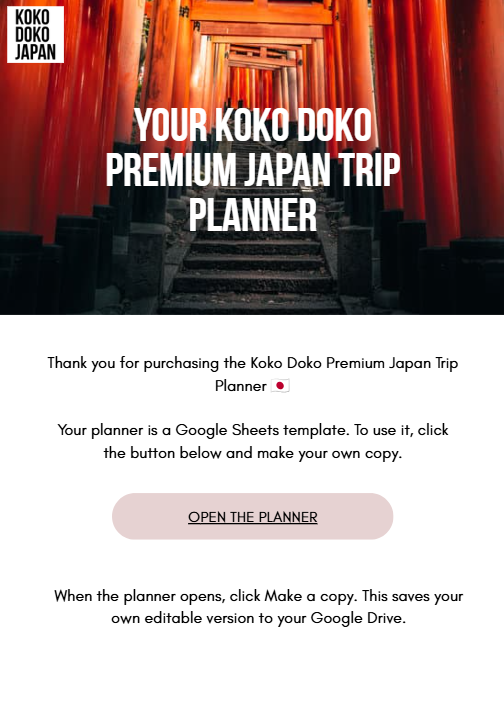
Planning Japan and drowning in saved TikToks, Google Maps pins and half-finished notes?
The Koko Doko Premium Japan Trip Planner is an editable Google Sheets template designed to help first-time travellers organise their trip clearly before they book everything.
Use it to plan your route, daily itinerary, hotel details, transport notes, bookings, budget, food ideas, packing, and Japan travel checklist — all in one place.
This is a Google Sheets template. You will need a free Google account to make and edit your own copy.
This is a digital product. No physical item will be shipped.
Due to the nature of digital downloads, refunds are not usually available once the file has been accessed/downloaded.
For personal use only. Please do not resell, redistribute, or share the planner link.